
A Behavioural Systems Perspective
Procrastination is commonly framed as poor time management or lack of discipline. This view is simplistic and inaccurate. Procrastination is better understood as a self-reinforcing psychological loop driven by emotional regulation, cognitive avoidance, and threat-based motivation.
It is not a failure of action, but a predictable system that pulls capable individuals into recurring cycles of delay, stress, and last-minute overdrive.
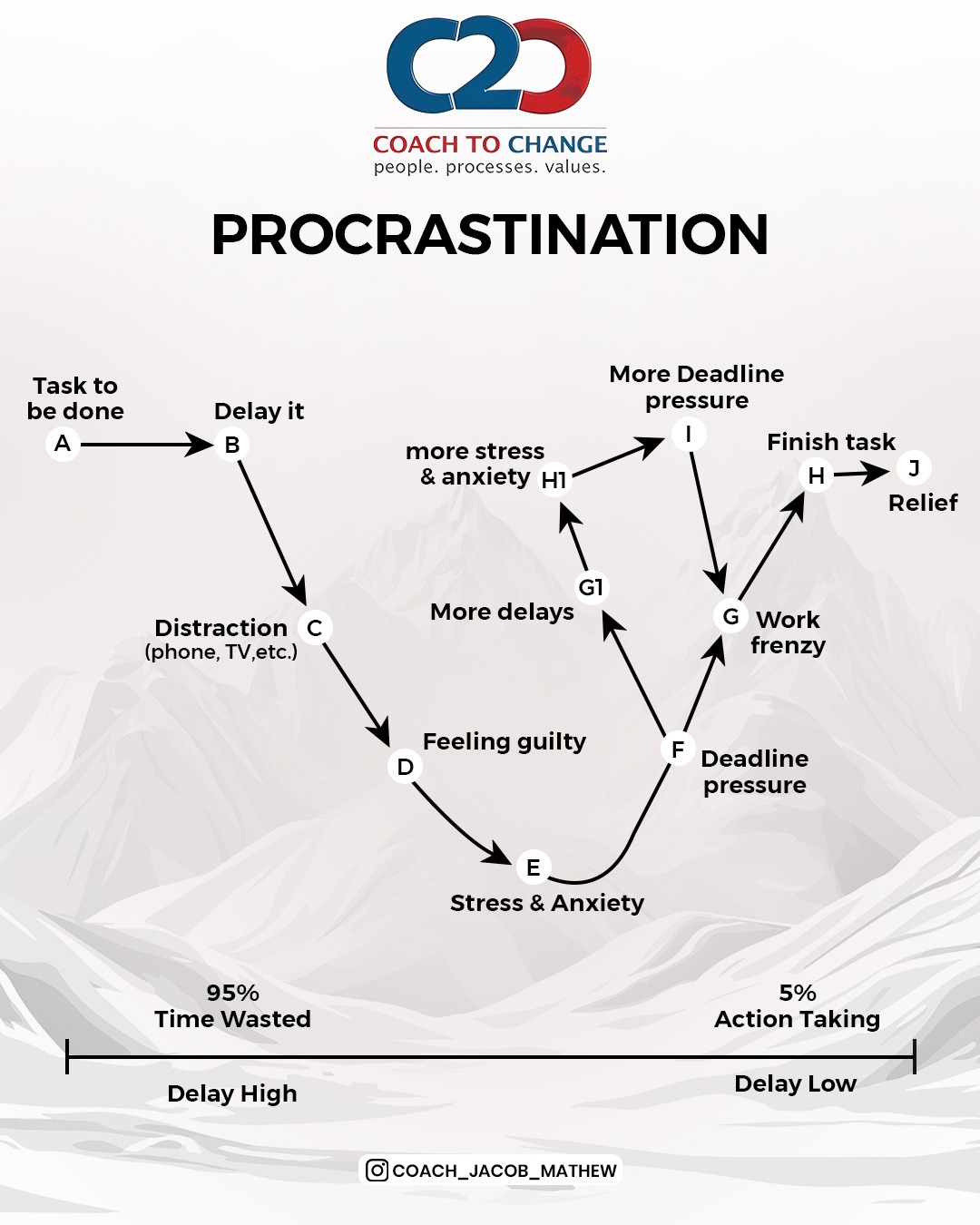
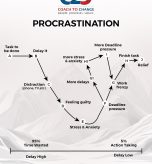
Phase 1: Task Activation and Avoidance (A → B)
When a task is identified, the brain automatically evaluates it. If it triggers uncertainty, fear of failure, perfectionism, or cognitive overload, the nervous system perceives it as a threat. Emotional safety is prioritised over effort, and delay becomes the response. At this stage, procrastination is avoidance driven by emotional discomfort—not laziness.
Phase 2: Distraction as Emotional Regulation (B → C)
Avoidance quickly gives way to distraction. Low-effort activities provide short-term emotional relief through dopamine. Discomfort temporarily subsides while the task remains cognitively active, reinforcing the avoidance loop.
Phase 3: Guilt, Stress, and Cognitive Load (C → D → E)
As distraction loses effectiveness, unresolved threat resurfaces. Guilt, stress, anxiety, increased cognitive load, and mental fatigue emerge. Energy is consumed without progress, while clarity, working memory, and decision quality decline.
Phase 4: Deadline Pressure and Forced Activation (E → F → G / E → F → G1 → H1 → G)
As deadlines approach, the nervous system shifts into survival mode. Action occurs not because the task feels meaningful, but because the cost of inaction becomes intolerable. Execution is urgency-driven, attention narrows, and problem solving becomes reactive. What is often called working best under pressure is actually threat-conditioned performance.
Phase 5: Completion, Relief, and Reinforcement (G → H → J)
Task completion produces relief rather than satisfaction. That relief reinforces the entire loop. The brain learns that avoidance brings comfort, stress forces action, and completion removes discomfort, strengthening future cycles.
Strategic Insight
Procrastination is not a willpower deficit. Sustainable change comes from intervening early by reshaping task perception, emotional safety, and identity-level beliefs. When a task feels safe, meaningful, and achievable, delay loses its psychological function.