
Goal achievement is rarely a straight line. What we often see as lack of discipline or inconsistency is in fact a predictable human pattern driven by cognition, emotion, and effort allocation.
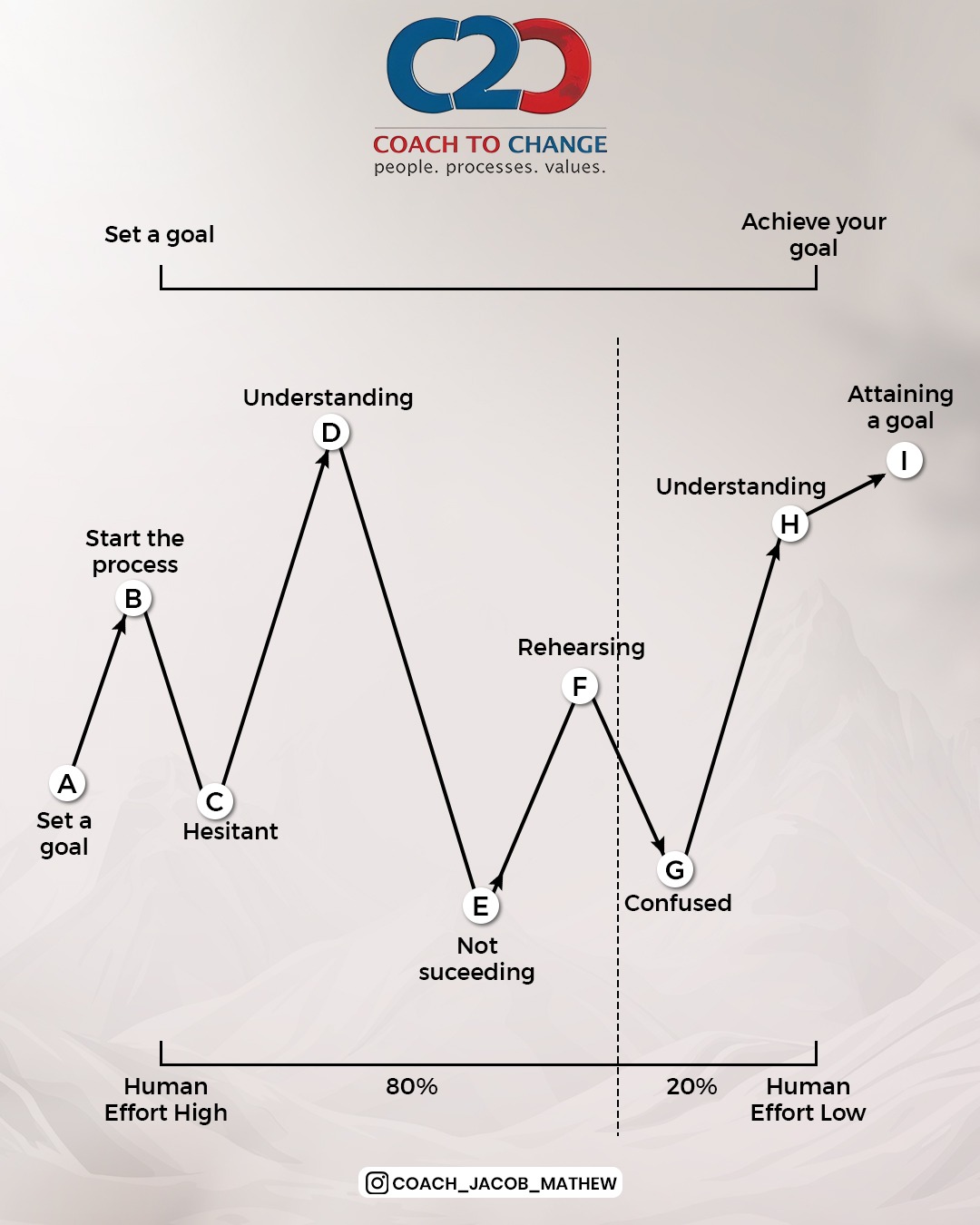
The Coach to Change Goal Progression Model illustrates this non linear journey and explains why most individuals experience turbulence long before sustainable success.
Phase 1, High Human Efforts, Low Clarity
The journey begins with intention.
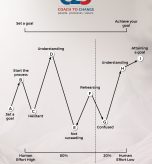
At point A, a goal is set. Motivation is high, but understanding is still superficial. At point B, action begins, yet reality quickly introduces friction. This leads to point C, hesitation, where doubt, fear, and cognitive overload emerge. This is not failure, it is the nervous system responding to uncertainty.
At point D, understanding improves. The individual gains insight into what the goal truly requires. However, awareness alone does not equal mastery.
Point E represents the lowest emotional dip, not succeeding. This is where most people abandon their goals. Importantly, this stage consumes nearly 80 percent of total human effort. The energy spent here is emotional regulation, trial and error, self correction, and mental endurance.
This phase is uncomfortable because progress is internal before it becomes visible.
Phase 2, Rehearsal and Cognitive Integration
At point F, rehearsal begins. Behaviour starts aligning with understanding. Systems replace willpower. Feedback loops shorten. The individual is learning how to learn.
Point G, confusion, often reappears, but with a crucial difference. The confusion is now informational, not emotional. This marks the transition point where effort begins to reduce.
Phase 3, Low Human Efforts, High Alignment
At point H, understanding deepens into embodiment. Actions feel natural rather than forced. Decision fatigue reduces. Identity aligns with behaviour.
Finally, at point I, the goal is attained. Not through intensity, but through integration.
Only 20 percent of human effort is required in this phase because systems, habits, and clarity now do the work.
Key Insight for Leaders and Individuals
Most people quit in the 80 percent zone because they misinterpret struggle as incompetence. In reality, struggle is a sign of neural adaptation and behavioural rewiring.
Sustainable success is not about pushing harder. It is about staying present long enough for understanding to mature into ease.
This model reframes failure as a necessary developmental stage, not a personal flaw.
Growth is not linear. But it is predicable when we understand how humans actually change.